What an RS-485 transceiver does — and when you need CAN instead
Unit load, node count, data rate, bus fault tolerance and ESD: the five numbers that decide which transceiver goes on your board.
Who this is for: Engineers choosing a bus transceiver for an industrial link, and buyers matching a cross-reference.
An MCU's UART speaks single-ended logic levels over a few centimetres. A transceiver turns that into a differential signal that survives hundreds of metres of cable in a factory. Which transceiver you need depends on which bus you are joining and how many devices share it.
RS-485: the multi-drop workhorse
RS-485 is a differential, half-duplex, multi-drop bus — one twisted pair, many devices, one talking at a time. It is what Modbus RTU runs on, and it is everywhere in meters, drives, HMIs and building automation. The five numbers that matter:
- Supply voltage. A 3.0-5.5 V part works from either a 3.3 V or a 5 V rail, which means one part number across designs.
- Data rate. Modbus RTU rarely exceeds 115.2 kbps, but headroom costs nothing.
- Unit load. The RS-485 standard defines a "unit load"; a full-load transceiver limits you to 32 devices on a segment. A 1/8 unit-load receiver puts one eighth of that burden on the bus, so up to 256 devices can share the segment without repeaters.
- Bus fault tolerance. Real installations get miswired. A part that tolerates -15 V to +15 V on A and B survives a field wiring mistake that would destroy a narrower part.
- ESD rating on the bus pins. The A/B pins go out to a connector someone will touch. 15 kV HBM on those pins is worth having.
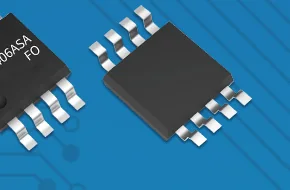
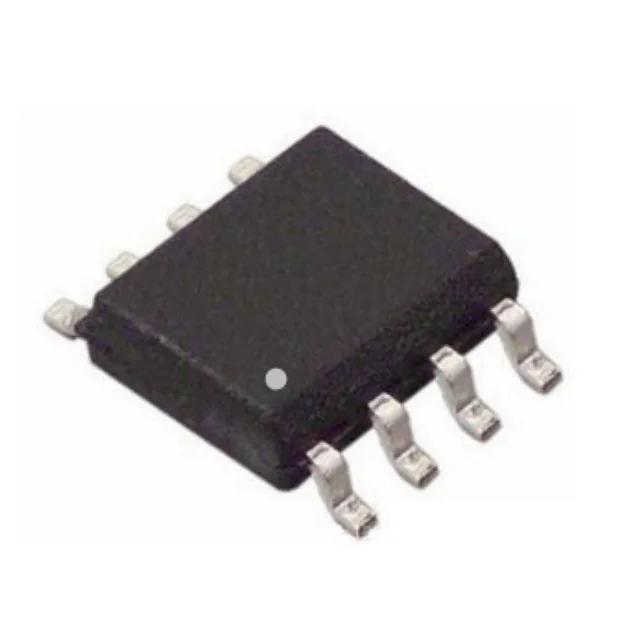
SCM3406ASA is MORNSUN's half-duplex RS-485 transceiver against that list: 3.0-5.5 V single supply, up to 10 Mbps, 1/8 unit load for up to 256 nodes, -15 V to +15 V bus fault tolerance, 15 kV HBM ESD protection on the bus pins, driver short-circuit protection, in an SOP-8.
Isolated or not?
A plain transceiver shares its ground with the bus. Over a long cable between two machines with separate earths, that ground difference becomes a current through your board. If the two ends can sit at different potentials — different buildings, motor drives nearby, outdoor runs — use an isolated transceiver module rather than a bare IC. MORNSUN's TD series covers this; ask us and we will quote from it.
CAN: when the bus has to arbitrate
CAN solves a different problem. Any node can start transmitting, collisions are resolved by message priority rather than by a master, and the protocol handles error detection and retries in hardware. That makes it the right choice for distributed control where several devices originate messages — vehicles, mobile machinery, and increasingly industrial equipment. CAN FD raises the data rate in the payload phase, which is why modern transceivers are specified for it.
SCM3425ASA is a high-speed CAN transceiver: fully compliant with ISO 11898, supports CAN FD at up to 5 Mbps, tolerates -42 V to +42 V on CANH/CANL, operates from -40 °C to +125 °C ambient, in an SOP-8.
Choosing between them
| RS-485 (SCM3406ASA) | CAN / CAN FD (SCM3425ASA) | |
|---|---|---|
| Typical protocol | Modbus RTU, Profibus-style field buses, meter buses | CANopen, J1939, proprietary control networks |
| Access | Half duplex, master polls | Multi-master, priority arbitration |
| Max signalling rate | 10 Mbps | 5 Mbps (CAN FD) |
| Nodes on one segment | Up to 256 (1/8 unit load) | Set by the network design |
| Bus voltage tolerance | -15 V to +15 V at A/B | -42 V to +42 V at CANH/CANL |
| Package | SOP-8 | SOP-8 |
From the current MORNSUN datasheets; revisions and check dates are on each product page.
Powering the interface
An interface still needs a rail. If it sits on a 24 V board and needs a local 5 V or 3.3 V, SCM1301ATA — a 4.5-40 V input, 1 A buck regulator in TSOT23-6L — or a ready-made K78 module does the job. If the interface has to float, it needs an isolated DC/DC as well as an isolated transceiver.
Ask about transceivers and reels
Written by Raitop. Product parameters are taken from MORNSUN official datasheets; see each product page for the source, the datasheet revision and the date it was checked.