Sizing a 24 V DIN rail power supply for a control panel
How to get from a load list to a part number, why the derating curve matters more than the headline wattage, and where the MORNSUN LIMF sizes sit.
Who this is for: Control and panel engineers sizing the 24 V supply for a cabinet, and the people who buy it.
Most 24 V DIN rail supplies are chosen by adding up a load list and rounding up. That works until the cabinet gets hot or something with a big inrush is switched on, so it is worth doing the other three steps as well.
Step 1 — the honest load list
List every 24 V consumer with its maximum current, not its nominal one: the PLC CPU and every I/O card, the HMI, the field sensors, the solenoid valves, the contactor coils, the safety relays, the fans. Analogue I/O loops are small but they add up. Add the current of anything a downstream DC/DC converter feeds, divided by that converter's efficiency.
Step 2 — inrush and simultaneity
Capacitive loads — HMI panels, DC/DC converters, LED drivers — draw a large current for a few milliseconds at switch-on. A supply with a well-behaved current limit and a hiccup/self-recovery overload characteristic can ride through this; one sized exactly at the steady-state figure may go into protection every time the panel is powered up. Decide which loads can start at the same time, and look at how the supply behaves at overload rather than only at its rated output.
Step 3 — temperature, then headroom
This is the step that gets skipped. A supply rated at 240 W is rated at 240 W up to a stated ambient, and derates above it. Inside a sealed steel cabinet in a plant room, 50 °C is normal and 60 °C is not unusual. Take the derated output at your cabinet temperature, and then aim to load it to roughly 70-80% of that. The headroom buys you a longer electrolytic capacitor life, a quieter thermal profile and room for the two extra sensors that always get added later.
Step 4 — pick the size
| Part | Output | Rated power | Efficiency | Input | Typical panel |
|---|---|---|---|---|---|
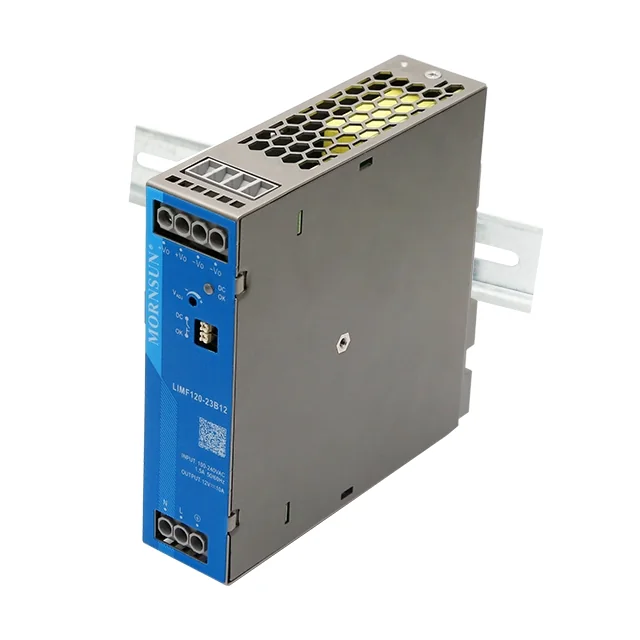
| LIMF120-23B24 | 24 V / 5 A | 120 W | 93% | 85-277 VAC | A small machine or pump panel: compact PLC, a handful of sensors, a few valves |
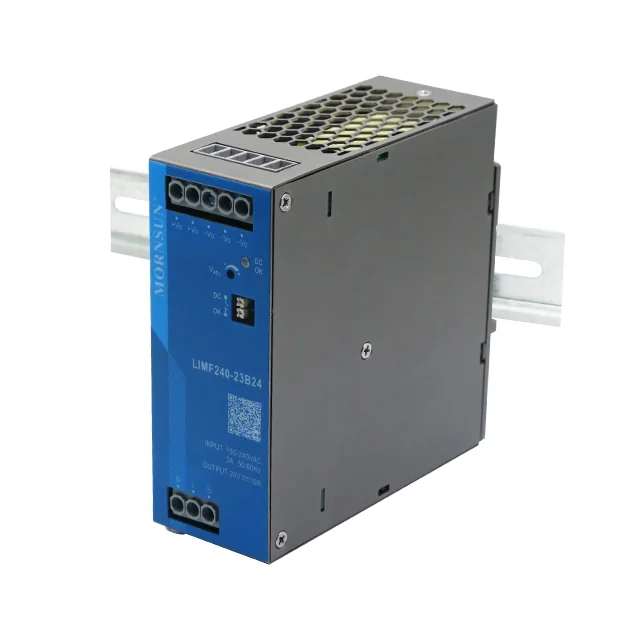
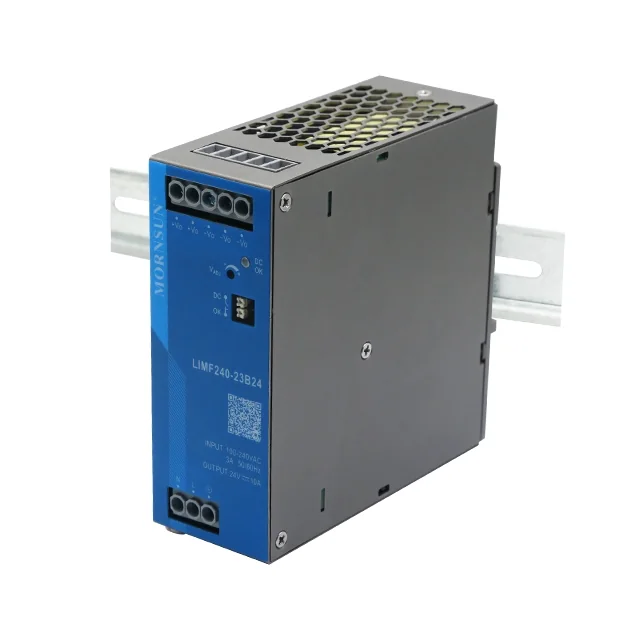
| LIMF240-23B24 | 24 V / 10 A | 240 W | 94% | 85-277 VAC | The usual mid-size choice: PLC with several I/O racks, an HMI, valve island, field devices |
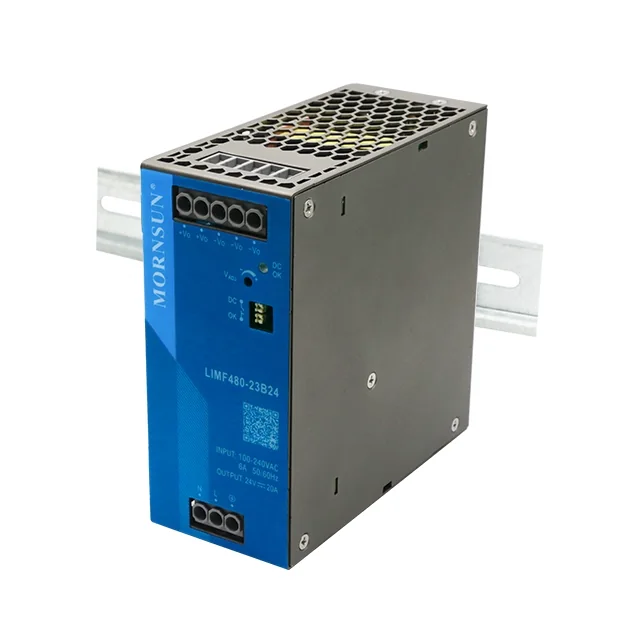
| LIMF480-23B24 | 24 V / 20 A | 480 W | 95% | 85-277 VAC | A large line panel, or one 24 V bus feeding several sub-panels |
All three share an 85-277 VAC input and 4000 VAC isolation, so the same design works on 110 V and 230 V networks without a part change.
12 V and 48 V on the same rail
If the panel also needs another voltage, the same family covers it — for example LIMF120-23B12 (12 V / 10 A) or LIMF240-23B48 (48 V / 5 A). Two supplies on the rail is usually simpler and more robust than one supply plus a chain of DC/DC converters, unless the second rail is small — in which case a K78 step-down module on the board is neater.
Redundancy
If the process cannot tolerate losing 24 V, the usual arrangement is two supplies through a redundancy module rather than one larger supply. Tell us if you need that and we will quote the matching parts.
Send us your load list
If you would rather not do the arithmetic twice, send the load list, the cabinet temperature and the mains voltage, and we will propose a size with the derating curve marked up.
Written by Raitop. Product parameters are taken from MORNSUN official datasheets; see each product page for the source, the datasheet revision and the date it was checked.