AC/DC or DC/DC: which converter does your design actually need?
The difference is what you feed it, not how it works inside — plus isolation, safety approval and where each one belongs in a system.
Who this is for: Engineers new to power module selection, and anyone reconciling a schematic with a parts list.
The two names describe the input, not the topology. An AC/DC converter takes mains and produces a DC rail. A DC/DC converter takes a DC rail and produces a different DC rail. Most industrial designs use both, in that order.
AC/DC converters
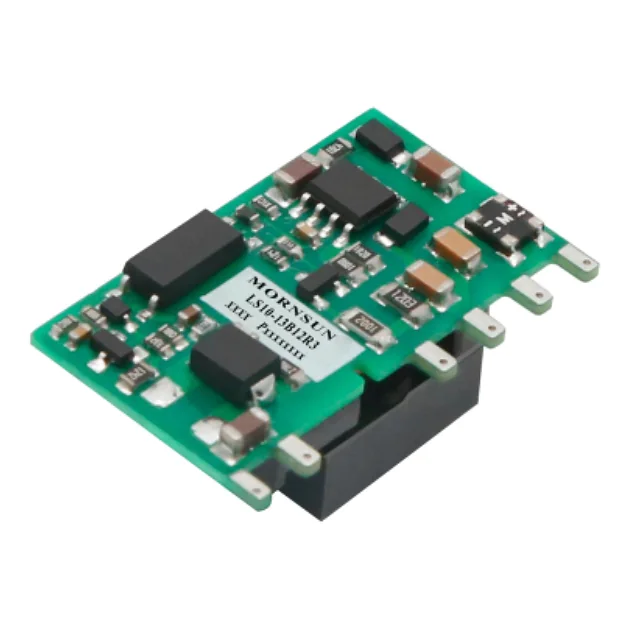
An AC/DC converter is the mains interface. Internally it rectifies, filters and then switches, so it has to deal with everything the mains does: surges, dips, line transients, inrush at switch-on and conducted emissions going back out. That is why an AC/DC part carries a safety approval, a stated input-to-output isolation voltage (typically 3000-4000 VAC) and an EMC specification, and why it is physically larger than a DC/DC converter of the same power.
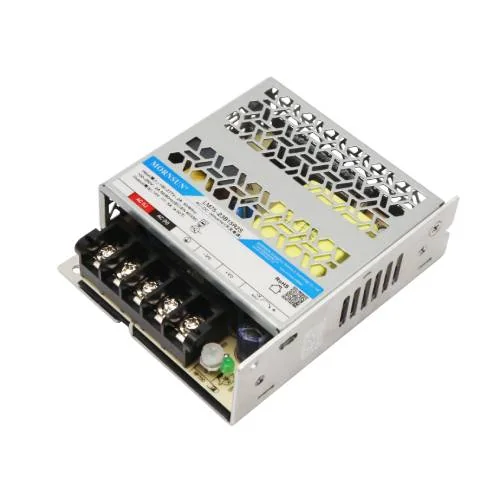
They come in three shapes: on-board modules that solder to your PCB, enclosed metal-case supplies that bolt to a chassis, and DIN rail supplies that clip into a cabinet.
DC/DC converters
A DC/DC converter sits after the mains stage. It exists because a system rarely runs on one voltage: a 24 V panel rail has to become 5 V for the logic and 3.3 V for the MCU, or an isolated 5 V has to be created for a floating RS-485 interface.
The key split is isolated versus non-isolated:
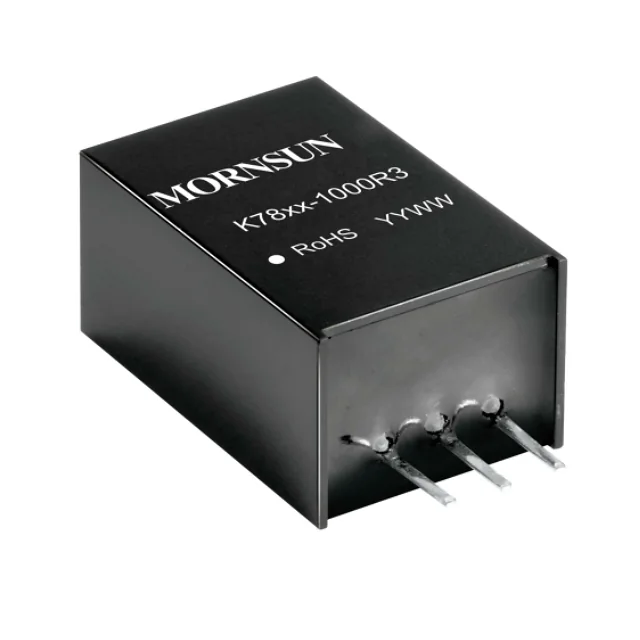
- Non-isolated (buck/step-down) — input and output share a ground. Small, cheap, efficient. Use it for a rail-to-rail conversion inside one board. The K78 family is this: a drop-in replacement for a 7805-style linear regulator that gets rid of most of the heat.
- Isolated — a transformer separates input and output. Use it when the two sides must not share a ground: a floating interface, a measurement front end at a different potential, or a ground loop you need to break.
Choosing, in practice
| Your input is… | You need… | Example |
|---|---|---|
| Mains, and the board must be self-contained | An on-board AC/DC module | LS10-13B24R3 — 10 W, 24 V |
| Mains, feeding a whole assembly from a chassis | An enclosed AC/DC supply | LM75-23B24R2S — 76.8 W, 24 V |
| Mains, feeding a control cabinet | A DIN rail AC/DC supply | LIMF240-23B24 — 240 W, 24 V |
| An existing 24 V rail, and logic needs 5 V | A non-isolated DC/DC step-down | K7805-1000R3 — 5 V / 1 A |
| An existing rail, and the output must float | An isolated DC/DC converter | Ask us — MORNSUN's isolated DC/DC range is wide and not all of it is published here |
Three things people get wrong
Using a DC/DC on mains. The DC input range printed on an AC/DC module (say 100-430 VDC) is there because the module rectifies AC internally; it does not mean an ordinary DC/DC converter can be connected to a rectified mains rail. Safety isolation and creepage are designed in, not added later.
Assuming isolation where there is none. A step-down module shares its ground with its input. If you need galvanic separation, you need an isolated part, and the datasheet will state the isolation voltage.
Sizing the DC/DC on the output only. A 5 V / 1 A output at 90% efficiency pulls about 5.6 W from the 24 V rail — add that, not 5 W, to the upstream load list.
Written by Raitop. Product parameters are taken from MORNSUN official datasheets; see each product page for the source, the datasheet revision and the date it was checked.